WORKSHOP RECAP · SEPTEMBER 5, 2026 · 3 MIN READ
There is a moment from Friday’s Good Bones workshop that is hard to shake. Moh’s Taha walked up to the whiteboard, pressed his marker down, and said: “This is all you start with.”
One dot.
By the end of the session, that single point had a horizon line running through it, vanishing points pulling walls and arches into depth, and — without anyone in the room quite noticing the transition — a complete 3D cityscape hanging in the air. The whole room went quiet for a second. Someone said oh. Just that.
That is what understanding perspective does. It doesn’t only teach you to draw better. It teaches you to look differently.
What we covered at Mumbai Fusion
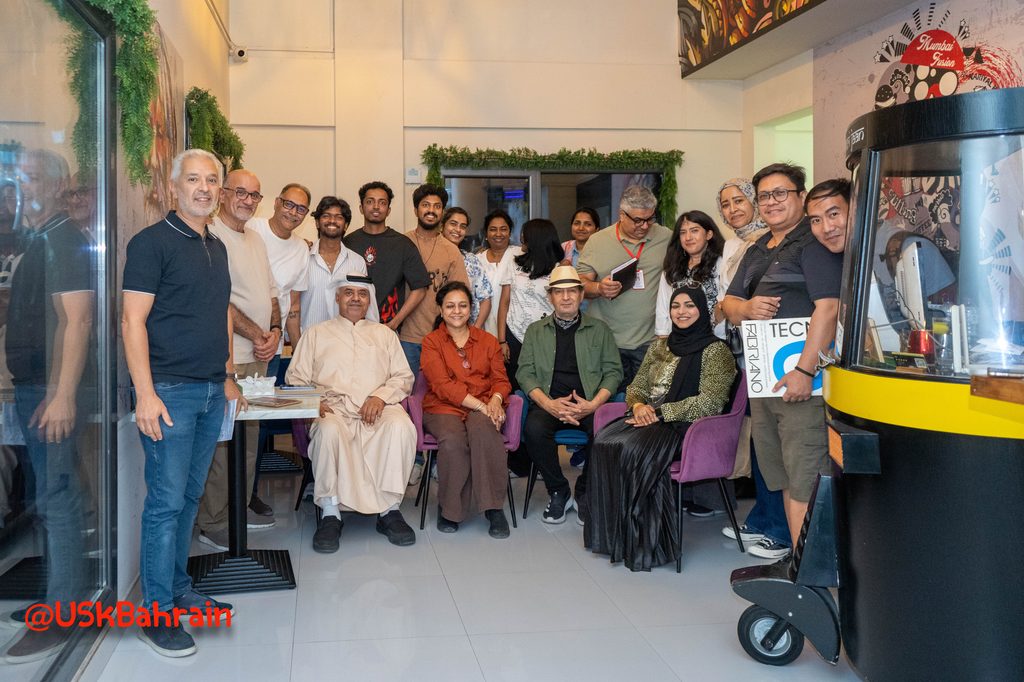
The session was held at Mumbai Fusion in Bahrain — a fitting venue, actually, for a workshop about layers and structure beneath the surface. Moh’d Taha, USk Bahrain member, artist, and educator, led us through one-point perspective first: a single vanishing point sitting on the horizon, buildings and streets converging toward it. Then two-point — corners, edges, and depth created by two vanishing points pulling in opposite directions.
The thread running through everything was the eye-level line. Where you plant that line — where you decide your eye sits — determines everything that follows. Objects below your eye level tilt up toward it. Objects above tilt down. The horizon is not out there in the world somewhere. It is a record of where you are standing.
“Your eye level is a decision, not a given. The structure doesn’t move — your relationship to it does.”
That realisation is the one worth taking out to the field. Because when you sit down at a heritage site in Bahrain, you have already made dozens of perspective decisions — without realising it. The workshop gave us the language to make them on purpose.
Applying this at Bahrain’s heritage sites
The two sites we kept returning to in conversation during the session were Qal’at al-Bahrain and Bab Al Bahrain. Both carry centuries of building — layers, additions, and different periods stacked on top of each other. Both reward exactly what Good Bones trained: the discipline to find your vanishing points before you commit a single line.
Qal’at al-Bahrain / Bahrain Fort
The Fort sits on a tell — an ancient mound — which means you are almost always looking at its walls from below or from the side. This makes your eye-level choice unusually visible. Sit near the base of the outer walls, and they tower above your horizon line, mass pressing upward; the Gulf disappears into the distance behind them, and the stones feel exactly as old as they are. Move to the archaeological plateau above, and the same structure flattens into a plan, all horizontal, a completely different conversation. Neither is wrong — but one-point perspective drawn from the lower position gives you a picture that a photograph rarely captures: the sheer vertical weight of 4,000 years of building, converging at a single point somewhere on the water’s edge.
Bab Al Bahrain
The gate’s main facade faces the souq, but the building turns a corner — and that corner is the subject. Two-point perspective is unavoidable here. Two walls recede in different directions simultaneously, with vanishing points that sit far off the left and right edges of your sketchbook. The trap is to treat it as a flat front elevation, a poster of itself. The reward is in committing to the corner: anchor your eye level at the top of the arch, plant your two vanishing points wide, and suddenly the building acquires weight and depth and the quiet authority of something that has presided over Manama for nearly a century. Because it has. You are not inventing that quality — you are finally drawing it honestly.
The question to ask before you sit down
Perspective is not a rule you follow. It is a question you ask before you uncap your pen: where am I, and what does that mean for everything I am about to draw?
Moh’s cityscape started with a dot. Your next sketch of the fort can start the same way. Find the point. Draw your horizon through it. Let the walls find their vanishing points. The rest is observation — which is the only thing urban sketching has ever really asked of us.
Before you scroll away
You’ve walked past Bab Al Bahrain hundreds of times. But have you ever actually drawn it — and discovered you’d been looking without really seeing?
Drop a comment below. Tell us which Bahrain landmark you’ve always meant to sketch but haven’t yet — and why. The answer might surprise you.
If you missed the workshop, keep an eye on our events page — we are planning more sessions with members throughout the year. And if you head out to Qal’at al-Bahrain or Bab Al Bahrain with your sketchbook this week, tag us. We want to see where your eye level lands.
It was a wonderful experience being part of the Urban Sketchers Art Group event. 🎨
A heartfelt appreciation to this amazing non-profit organization for bringing artists together.
The sketching session was inspiring, creative, and full of positive energy.
Special thanks to Mr. Mohd Taha & Mr. Sadeq Shehab and other members, for organizing such a meaningful and enjoyable event.
His passion for art and sketching truly made the session special.
I loved the opportunity to observe, learn, sketch, and connect with fellow artists.
Events like these encourage creativity and make art more accessible to everyone.
It is beautiful to see an organization promoting art purely for the love of creativity and community.
I truly appreciate the time, effort, and dedication behind this wonderful initiative.
Looking forward to joining more Urban Sketchers events and creating many more artistic memories! ✨🖌️
I was lucky to have the chance of attending such valuable workshop with the master Mr. Mohamed Taha, and meet all of the members passionate about art. thank you Urban Sketchers Bahrain for arranging the workshop & see in other events.